WELCOME TO MY BLOG
STEREOTYPES OF MEXICO
Hello my name is Maria de los Angeles and I am studying law at the Universidad del Norte.
I opened this blog because I have a project throughout the vacacional about the country of Mexico.

First I will talk about the stereotypes of Mexico and Colombia, are two countries that can easily relate to one of the largest stereotypes of Colombia and is narcotics because both countries are well known for the fact that both are living drug trafficking to a large extent and likewise the violence.
Another great comparison that we can make between these two countries, Mexico and Colombia is that they are countries with a gastronomy and music that is often related to Colombia. In Mexico it is very common to eat tacos, burritos, lunches, tamales, gorditas, quesadillas … at any time and in any city, although there is also the possibility of eating a meal or going to the restaurant to taste enchiladas, chilaquiles, posole, menudo, chile poblano, mole, flutes etc.

In this sense Colombia is very similar, from early you can taste any type of fried: empanadas, stuffed potatoes, yucca or the famous arepas always accompanied by a red or a chocolate.
GENDER STEREOTYPES

For centuries, masculine stereotypes have been constructed in Mexican culture (as in other contexts) that characterize men as providers of the household, heads of families and, to a certain extent, decision-makers.
When productive work is considered the responsibility of the male, he is in the position of control and manage the economic and technological resources to which the exercise of the power, both public and private. On the contrary, the
work that the woman does at home is for consumption
immediate and, therefore, invisible and not valued economically
nor socially.
THE HOFTEDE MODEL FOR CULTURAL
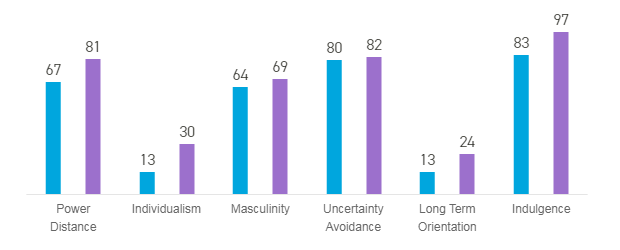
MEXICO IS THE PURPLE AND COLOMBIA IS THE BLUE
This dimension deals with the fact that all individuals in societies are not equal – it expresses the attitude of the culture towards these inequalities amongst us. Power Distance is defined as the extent to which the less powerful members of institutions and organisations within a country expect and accept that power is distributed unequally.
At a score of 81, Mexico is a hierarchical society. This means that people accept a hierarchical order in which everybody has a place and which needs no further justification. Hierarchy in an organization is seen as reflecting inherent inequalities, centralization is popular, subordinates expect to be told what to do and the ideal boss is a benevolent autocrat .
The fundamental issue addressed by this dimension is the degree of interdependence a society maintains among its members. It has to do with whether people´s self-image is defined in terms of “I” or “We”. In Individualist societies people are supposed to look after themselves and their direct family only. In Collectivist societies people belong to ‘in groups’ that take care of them in exchange for loyalty.
Mexico, with a score of 30 is considered a collectivistic society. This is manifest in a close long-term commitment to the member ‘group’, be that a family, extended family, or extended relationships. Loyalty in a collectivist culture is paramount, and over-rides most other societal rules and regulations. The society fosters strong relationships where everyone takes responsibility for fellow members of their group. In collectivist societies offence leads to shame and loss of face, employer/employee relationships are perceived in moral terms (like a family link), hiring and promotion decisions take account of the employee’s in-group, management is the management of groups.
A high score (Masculine) on this dimension indicates that the society will be driven by competition, achievement and success, with success being defined by the winner/best in field – a value system that starts in school and continues throughout organisational life.
A low score (Feminine) on the dimension means that the dominant values in society are caring for others and quality of life. A Feminine society is one where quality of life is the sign of success and standing out from the crowd is not admirable. The fundamental issue here is what motivates people, wanting to be the best (Masculine) or liking what you do (Feminine).
Both Mexico and Colombia are afraid of the unknown, the uncertainty of the unknown and they are not very risky people. The dimension Uncertainty Avoidance has to do with the way that a society deals with the fact that the future can never be known: should we try to control the future or just let it happen? This ambiguity brings with it anxiety and different cultures have learnt to deal with this anxiety in different ways. The extent to which the members of a culture feel threatened by ambiguous or unknown situations and have created beliefs and institutions that try to avoid these is reflected in the score on Uncertainty Avoidance.
The indulgence for both countries is very eleve since Mexico and Colombia are countries of people very friendly and given to contribute with the good. This dimension describes how every society has to maintain some links with its own past while dealing with the challenges of the present and future, and societies prioritise these two existential goals differently. Normative societies. which score low on this dimension, for example, prefer to maintain time-honoured traditions and norms while viewing societal change with suspicion. Those with a culture which scores high, on the other hand, take a more pragmatic approach: they encourage thrift and efforts in modern education as a way to prepare for the future.
CATEGORIZING A CULTURE

The culture of Mexico is the product of a process of mixing indigenous practices and traditions with the Spanish colonial presence, which ended up producing an indelible mark on all vital aspects. There has always been a struggle by Mexicans throughout their history to define and promote the identity of their nation. However, due to political instability, wars with the United States and France and the colonial presence, Mexican society has had to strive to create a cohesive identity.
SUBCULTURE
The most common urban tribes in Mexico are cholos, punks, floggers, skatos, chacas, emos, goths, hipsters, rockabillys and otakus.

They are natural groups of people, usually under 30 years of age, who share musical tastes, ways of dressing, places of encounter, hobbies and ways of thinking in general.
PUNKS
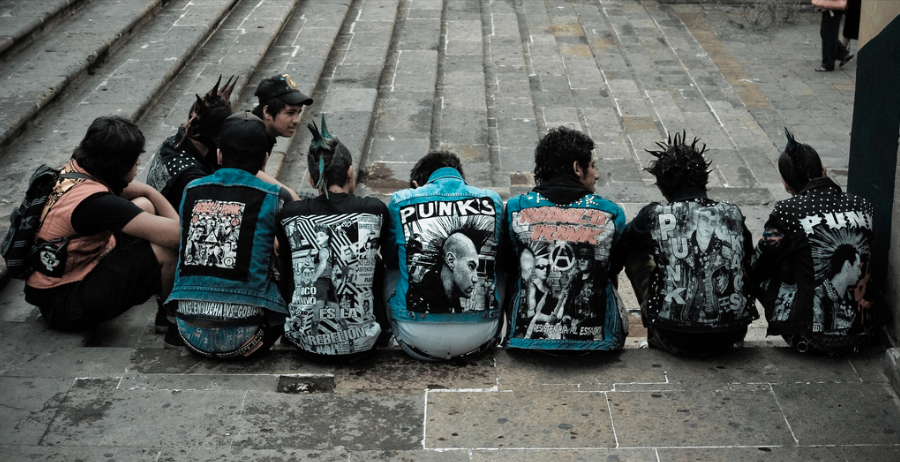
His name is due to the taste shared by punk music. This movement emerged in England as a rejection of the cultural trends of the time, at the end of the 70s.
The punks are characterized by bizarre hair styles, with cuts in tips and unconventional colors: phosphorescent yellow, blue, purple or pink.
Punk clothing consists of mixing leather and metal elements, such as chains, piercings and studs. In addition, they tend to delineate their eyes, wear military boots and have tattoos.
CHACAS

Chacas are commonly distributed in popular areas. The highest concentration of chacas is found in the delegations of Venustiano Carranza, Cuauhtémoc, Gustavo A. Madero and Iztapalapa, in Mexico City.
These are young people who do not exceed 22 years of age and combine urban music with the use of religious accessories.
Most of them are lovers of reggaeton, besides having quirky tastes as far as their costumes are concerned. There is a belief that the vast majority of Chacas do not study or work.
 blog de maria